Research
Prof Wang quoted in The Wall Street Journal
July 2026
Prof. Wang was interviewed by Molly Reinmann of The Wall Street Journal for a story on dating spreadsheets. He spoke about his article on data auxiliaries and self-datafication.
March 2026
Authors:
Skyler Wang and Isabella Luppi
Generative artificial intelligence (AI) has begun infiltrating the most ordinary domains of romantic life -- drafting apologies, softening reproaches, and decoding a partner's ambiguous messages. While recent scholarship on AI in intimate life has concentrated on chatbot companions, this article shifts the frame to AI as an intermediary in human-to-human romantic communication. Drawing on a multi-modal corpus of vernacular discourse from 2023 to 2026, we contribute two complementary concepts. The covert triad situates a structural change—a relationship phenomenally dyadic but operationally triadic, with the third party visible only to the partner who deploys the model. Articulation labor names the mechanism whereby the expressive component of emotional labor—converting felt experience into language that a partner can receive—is increasingly delegated to AI, even as feeling labor remains lodged in the user. Authenticity, under these conditions, is being reconfigured from a property of linguistic authorship to one of emotional ownership, a shift actively contested.
New preprint: "ChatGPT, help me draft a breakup text": The Covert Triad and Articulation Labor in AI-Assisted Romantic Communication
May 2026
Authors:
Samuel J Bell* and Skyler Wang* (*equal contribution)
Abstract:
Learning correlations from data forms the foundation of today's machine learning (ML) and artificial intelligence research. While contemporary methods enable the automatic discovery of complex patterns, they are prone to failure when unintended correlations are captured. This vulnerability has spurred a growing interest in interrogating spuriousness, which is often seen as a threat to model performance, fairness, and robustness. In this article, we trace departures from the conventional statistical definition of spuriousness—which denotes a non-causal relationship arising from coincidence or confounding—to examine how its meaning is negotiated in ML research. Rather than relying solely on formal definitions, researchers assess spuriousness through what we call pragmatic frames: Judgments based on what a correlation does in practice—how it affects model behavior, supports or impedes task performance, or aligns with broader normative goals. Drawing on a broad survey of ML literature, we identify four such frames: Relevance (Models should use correlations that are relevant to the task), generalizability (Models should use correlations that generalize to unseen data), human-likeness (Models should use correlations that a human would use to perform the same task), and harmfulness (Models should use correlations that are not socially or ethically harmful). These representations reveal that correlation desirability is not a fixed statistical property but a situated judgment informed by technical, epistemic, and ethical considerations. By examining how a foundational ML conundrum is problematized in research literature, we contribute to broader conversations on the contingent practices through which technical concepts like spuriousness are defined and operationalized.
“The Pragmatic Frames of Spurious Correlations in Machine Learning” published in Big Data & Society
Prof Wang quoted in CBC News
March 2026
Prof. Wang was interviewed by Sarah Petz of CBC News for a story on the infiltration of AI into the online dating world.
“On-Demand Intimacy” featured in The Atlantic
March 2026
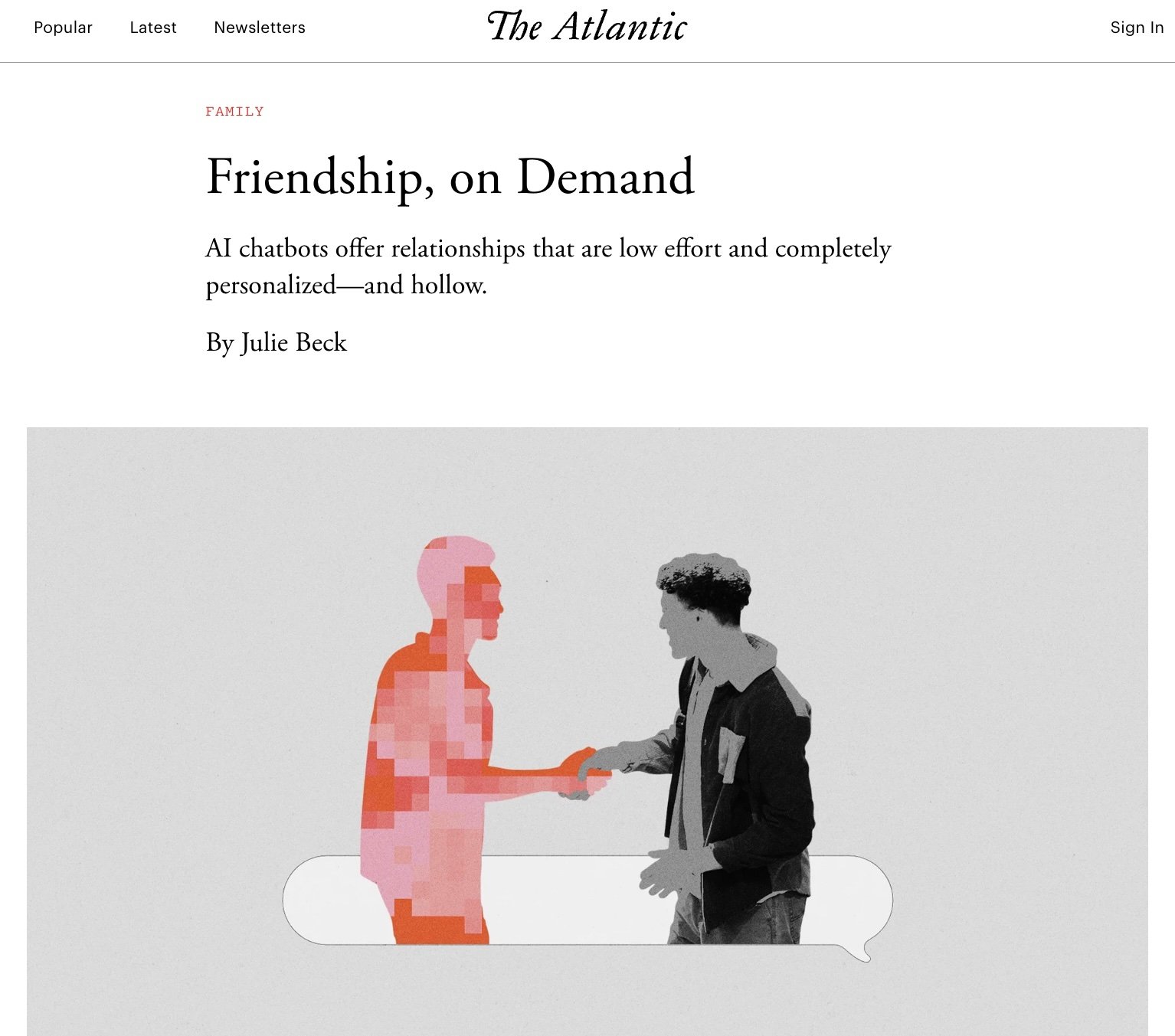
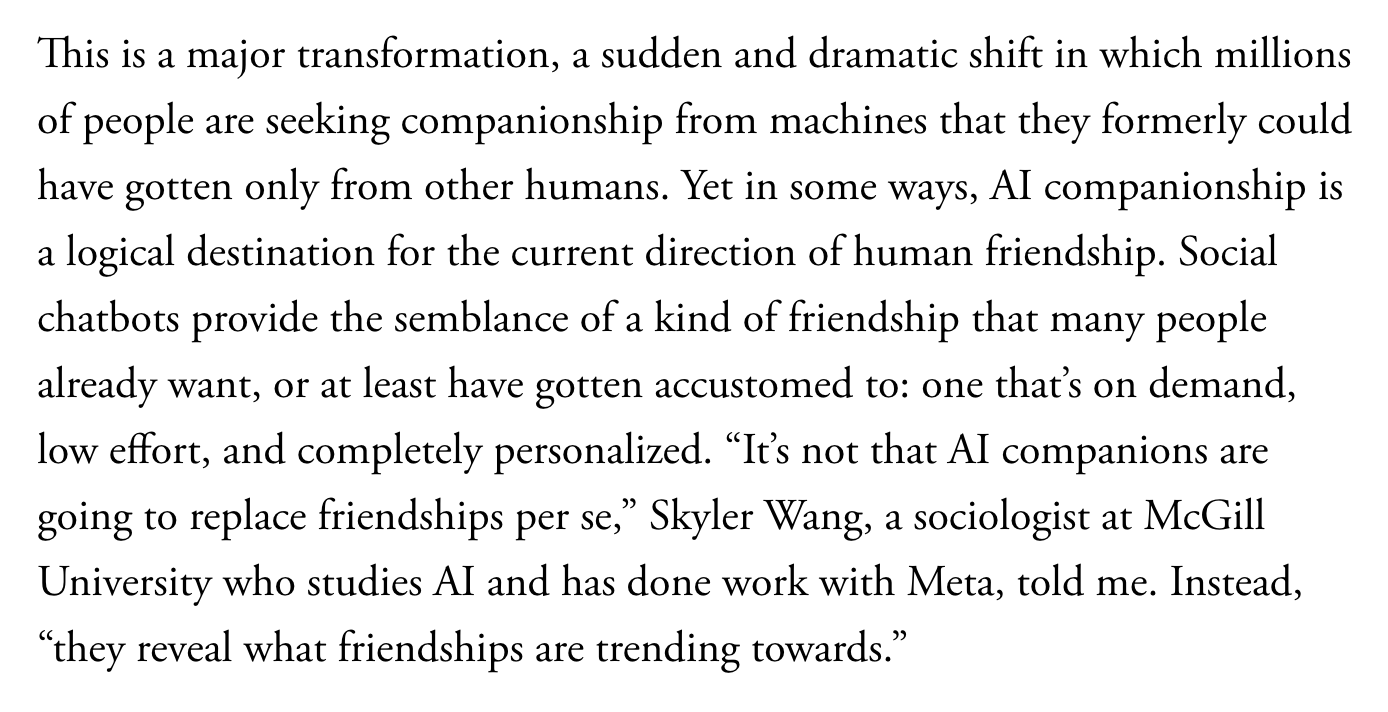
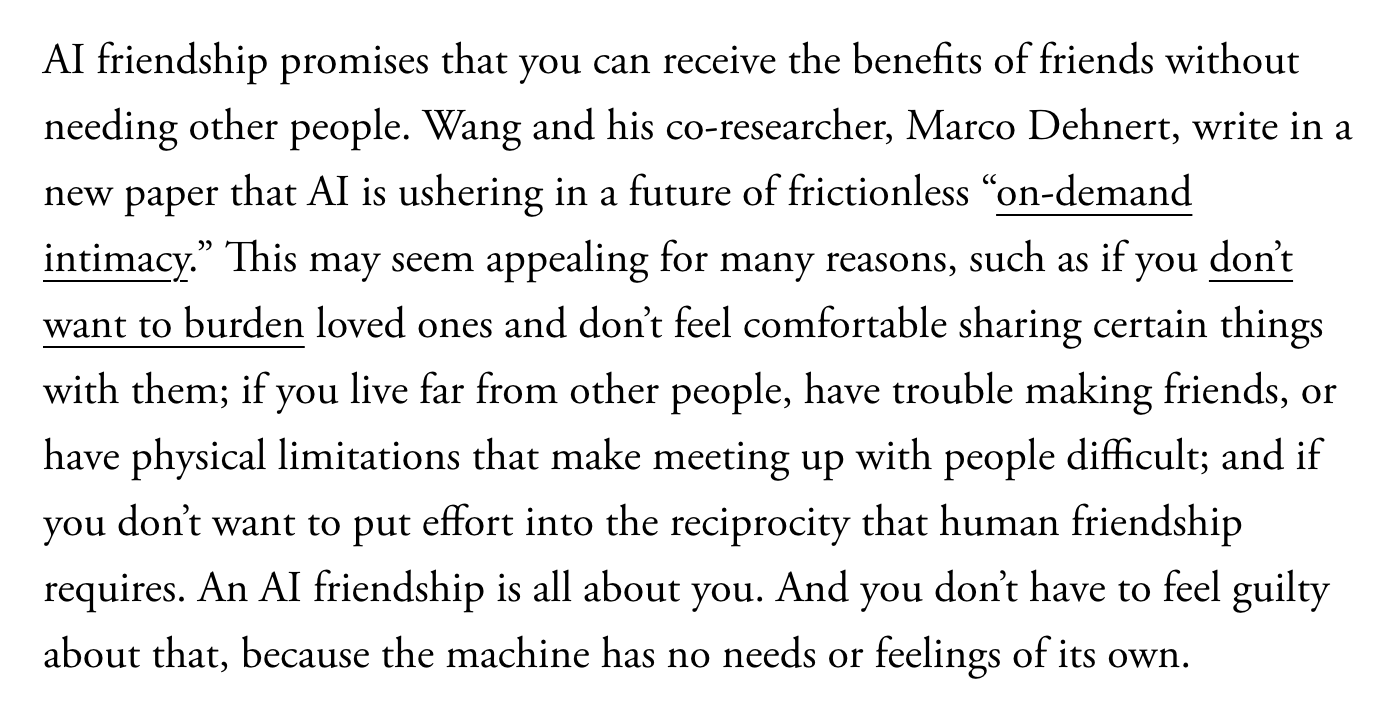
Prof. Wang was interviewed by Julie Beck from The Atlantic, which featured his article on “On-Demand Intimacy.” Click to read the full story.
January 2026
Authors:
Skyler Wang and Marco Dehnert
Abstract:
As a burgeoning industry, artificial intelligence (AI) companion platforms capitalize on shifting societal attitudes toward tech-mediated relationships to introduce novel ways of connecting with nonhuman entities. But how are these platforms constituted, and how do they “sell” consumers the idea of human-AI relationships? By analyzing four prominent multimodal companions (AvatarOne, Digi, Paradot, and Replika), we argue that despite differences in architecture and style, state-of-the-art platforms converge on the following sociotechnical qualities: human-likeness, accessibility, customizability, and relationship progression. By creating technical affordances to augment these qualities, companion platforms ultimately project what we call a future of on-demand intimacy – intimacy that can be acquired in a truly frictionless manner. Beyond examining how commercial entities mobilize the grammar of human intimacy in tandem with on-demand culture to create new markets, this study offers a conceptual framework for future research into how platform dynamics shape not only the availability but also the meaning of intimacy in human–AI interactions.